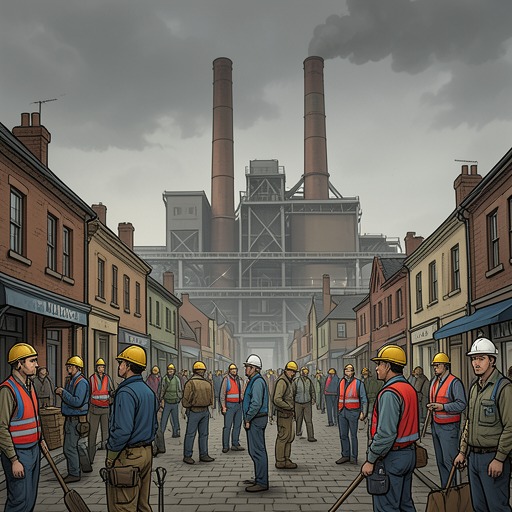
The common good as justification
Dead ShotThe common good as justification is the central moral alibi of Statenville’s hidden order. Nathan Gold, the town’s mayor, treats the protection of the town’s prosperity as grounds for restraining Cal Murphy, concealing the deaths of young men, manipulating evidence, and authorizing increasingly direct violence. The phrase does not merely excuse individual wrongdoing; it converts a criminal system into a civic duty, allowing its beneficiaries to imagine that coercion is sacrifice and secrecy is stewardship.
A Civic Alibi for Personal Power
Gold’s justification begins with the claim that Statenville itself is at stake. Cal Murphy’s reporting threatens to pull back the curtain on a town whose prosperity has been carefully constructed and protected. Gold knows that Cal sees Statenville as a temporary stop rather than a final home, and he regards the outsider reporter as someone who does not understand the value of what local power has built. The town’s image of stability therefore becomes more important than the truth about its foundations.
Gold takes pride in his moral and ethical conduct as mayor, but the threat to his way of life makes those principles negotiable. He tells himself that a temporary restraining order is necessary for the good of the whole, even though the decision is also a defense of his authority and reputation. His private grief over Riley Gold’s death is similarly absorbed into the larger argument: admitting that Riley overdosed on drugs would bring personal shame, public scrutiny, and damage to the town’s carefully maintained story. Civic language gives Gold a way to conceal self-interest beneath the appearance of sacrifice.
Prosperity Built on Silence
The justification depends on a sharply unequal distribution of knowledge. Most residents of Statenville do not know that there is a secret to keep, while Gold and his inner circle deliberately limit awareness to reduce the chance that a conscientious objector will expose the system. Those who do know are paid handsomely. Money purchases silence, and the resulting prosperity is presented as evidence that the arrangement works.
Gold’s reasoning is explicitly consequentialist: Statenville has jobs, residents are happy, and the town has become a boomtown instead of a failing rural community. The source of the money is treated as less important than the visible benefits it produces. Yet the people of Statenville never receive the information necessary to decide whether that bargain is acceptable. They are treated as pawns in a get-rich scheme, protected from the truth in the name of their own welfare. The common good is therefore not a shared decision or public standard; it is a conclusion imposed by Gold on people whose consent has been manufactured through ignorance.
The moral arithmetic also makes violence appear efficient. Paying off dissenters is considered better than murdering them because it raises fewer suspicions, but the distinction does not establish an ethical boundary. It shows only that the system prefers the method that protects its appearance. Gold recognizes that there are exceptions—people who cannot be bought—and Cal Murphy becomes one of them. Once Cal refuses the assigned price of silence, the language of public protection begins to authorize direct punishment.
From Official Narrative to Criminal Control
The doctrine first appears through the treatment of the three deaths. Sheriff Jones insists that the victims died of simple drug overdoses and objects to Cal Murphy’s use of the word murder. Methamphetamine has been found at all three scenes, but the official interpretation is asserted before toxicology reports return from Boise. When Kevin Mendoza suggests that the victims may have bled to death, he is told that they overdosed and is pressured to cancel the toxicology screens. The classification of death is thus not the neutral result of investigation; it is an administrative decision imposed before the evidence can speak.
The same logic turns law enforcement into an instrument of intimidation. Cal is arrested on trumped-up charges of possessing an open container and driving under the influence, although he knows neither charge reflects what happened. Sheriff Jones and Jake Dawkins use the machinery of booking, mockery, and detention to punish inquiry rather than to establish a legitimate offense. Cal understands that his arrest is a bullying tactic and realizes that the secret he is approaching threatens powerful people more than he had understood.
Inside Cloverdale Industries, the principle becomes an organizational command. Workers are warned that reporters have broken into the facility and are told to remember The Golden Rule and protect the company’s product by keeping a low profile. The euphemistic instruction converts secrecy and illegal distribution into disciplined collective behavior. The organization’s public respectability depends on employees accepting that obedience serves a larger purpose, even when the practical result is the protection of a drug operation.
Protecting the Secret by Destroying People
Buddy Walker’s deep-cover work exposes the contradiction most clearly. For five years, Walker has posed as a basketball coach and part-time janitor while investigating Cloverdale Industries for the Federal Bureau of Investigation. His objective is to determine the cartel’s reach, identify its key players, and assemble enough evidence for a sweep. His impatience contributes to a misstep, but the network responds not by answering the investigation, but by redefining the investigators as threats to public welfare.
After Cal Murphy and Kelly Mendoza are captured, Walker binds them to chairs and has their mouths sealed with duct tape. He interprets their detention as temporary hospitality in the service of protecting the common good, imagining that even meddlesome reporters will eventually understand the necessity of what he has done. The formulation is grotesque because it preserves the vocabulary of civic responsibility while stripping the captives of movement, speech, and legal protection.
When Nathan Gold learns that Walker is an FBI agent and that Elliott Mercer is involved, Operation Fuego is abandoned for Operation Cleanup. Gold’s men secure the two agents, force them to take methamphetamine, and plan to plant evidence that will discredit any federal case against Cloverdale Industries. Walker can be presented as a drugged janitor or as a coach associated with giving drugs to students, while Mercer’s credibility is likewise compromised. The common good here is no longer merely a rationale for withholding information; it is the language used to justify manufacturing a false reality and destroying the witnesses who could challenge it.
Exposure of the Moral Contradiction
The concept’s force comes from the contrast between Statenville’s visible success and its concealed human cost. A large municipal budget, employment, and the appearance of a happy small-town dream are set against dead young men, suppressed reports, coerced employees, compromised law enforcement, and abducted investigators. Gold can call the system protection only by ensuring that those who bear its costs do not know enough to object.
The phrase also circulates beyond Gold’s private reasoning. Employees repeat the rule, Walker invokes the common good while holding reporters captive, and Elliott Mercer tries to shape the eventual story so that the Federal Bureau of Investigation appears innocent and the public is supposedly protected. Each repetition turns a personal excuse into an institutional norm. The system survives not only through guns, money, and official power, but through a shared vocabulary that makes resistance look selfish and concealment look responsible.
Cal Murphy’s refusal marks the limit of that vocabulary. Because he continues investigating despite arrest, threats, and abduction, he becomes the exception Gold cannot absorb through payment or persuasion. The common good as justification is consequently revealed as a mechanism for controlling who may define reality. Its decisive irony is that the town is said to be protected from the truth, while the truth is precisely what would allow its residents to judge whether their prosperity deserves to survive.